Best Walking Stick for Balance: How to Choose the Right One for You
If you've found yourself Googling "best walking stick for balance," you're probably at a particular kind of crossroads, one where you know you need some support, but you're not entirely sure what you need, or whether a walking stick is even the right answer.
Here's what we know from years of working with people exactly like you: the right walking stick, fitted correctly and chosen for your specific needs, can be genuinely life-changing. The wrong one, or the right one at the wrong height, can make things worse.
This guide will help you work out what you actually need.
First: Is a Walking Stick Right for You?
A walking stick is appropriate for balance support when you need a single point of contact with the ground to feel more stable particularly on uneven surfaces, when you're fatigued, or when one side of your body is less reliable than the other.
If you find yourself reaching for walls, furniture, or other people's arms regularly, a walking stick is almost certainly worth trying. If your balance issues are more severe, or you're recovering from surgery or a significant injury, you may need something with more support, like forearm crutches, at least initially.
Not sure which is right for you? Our mobility aid quiz takes about two minutes and gives you a personalised recommendation.

Folding Walking Stick vs Non Folding Cane: Which Is Better for Balance?
If balance is your primary concern, a non-folding walking stick will generally give you more stability. Fixed sticks are a single piece, which means there's no flex or play in the shaft, what you put into it comes straight back as support.
That said, modern folding sticks have improved significantly. A high-quality folding walking stick with an ergonomic handle, shock absorbing rubber tip and wrist strap performs very well for everyday balance support and has the significant advantage of packing down when you don't need it.
If you're asking whether folding sticks are safe - we've written the full guide on that - but the short answer is yes, if you buy a well-made one and check the locks regularly.
Which Handle Type Works Best for Balance?
The handle is your primary contact point with the stick, and if you're using it every day, it's the difference between a walking aid that genuinely supports you and one that creates a whole new set of problems.
Most people don't think about handle design until something starts hurting. Then they think about it a lot.
Here's the honest breakdown of what's out there, and why most standard handles fall short.
Crook handle (the traditional curved walking stick shape). The classic silhouette most people picture when they think "walking stick." It looks elegant, but it's designed for occasional use and light support, not daily balance assistance. The narrow curved shape concentrates pressure into a small area of the palm, which means extended use causes cramping, skin irritation, and palm pain. If balance is your primary reason for using a stick, this is the handle to avoid.
Derby handle (the rounded, offset handle). The most widely available handle type, and a significant step up from the crook in terms of weight distribution. The offset shape means your wrist sits in a more natural position than with a crook, and the rounded form spreads load more evenly across the palm. For light or occasional use it works reasonably well. The limitation is that it's a hard, unpadded surface with no ergonomic moulding, so during sustained daily use pressure builds up across the palm, grip fatigue sets in, and for anyone with joint sensitivity, nerve pain, or skin conditions, it becomes uncomfortable fairly quickly. It's a functional handle. It's not a comfortable one for the long term and as a result can lead to blisters, callouses, joint pain and other more serious problems.
Fischer handle. Specifically moulded to the shape of the hand, which sounds ideal. In practice, the fixed moulding means it only works well if your hand matches the mould, and for many people, particularly those with smaller hands, hypermobile joints, or asymmetric grip, it creates as many pressure points as it solves.
T-bar handle. A flat, horizontal grip that distributes weight more evenly than a crook or derby. Better than the traditional shapes for extended use, and a common NHS issue option. The problem is that a hard, flat surface, however well it distributes weight, is still a hard, flat surface. Without cushioning, pressure builds up across the palm and fingers during sustained use, particularly for people with arthritis, EDS, fibromyalgia, or any condition affecting hand sensitivity. Grip fatigue and palm soreness are the most common complaints from daily users.
Ergonomic handle with cushioned padding. This is where design and reality actually meet. An ergonomic moulded handle is shaped to follow the natural contours of the hand and wrist, guiding your grip into the correct position rather than leaving your hand to find its own way on a hard, generic surface. The shape distributes load across the full palm, reduces the angle the wrist has to hold, and eliminates the pressure concentration that causes cramping and joint strain with other handle types.
Cushioned padding is the other half of the equation, and it's the part most walking stick manufacturers skip entirely. Soft padding absorbs the impact transmitted through the stick with every step, protects the skin from the repetitive friction that causes blisters and calluses, and reduces vibration into the hand and wrist. For anyone with joint sensitivity, nerve pain, or skin that bruises or breaks easily, this isn't a luxury addition. It's the thing that makes a walking stick genuinely usable every day.
The combination of ergonomic moulding and cushioned padding is what Cool Crutches walking sticks are built around. It's the reason customers who've used NHS-issued or standard retail sticks notice the difference within the first hour of use, not because our sticks look different, but because they feel different. Less fatigue, less discomfort, less of the compensatory tension in the shoulder and neck that builds up when your hand is working against an ill-fitting grip all day.
If you already experience hand or wrist pain when using a stick, or if you've noticed your grip tightening or your shoulder creeping upward as the day goes on, the handle is almost certainly part of the reason. It's worth getting it right.

The Ferrule: The Part Everyone Ignores Until It Fails Them
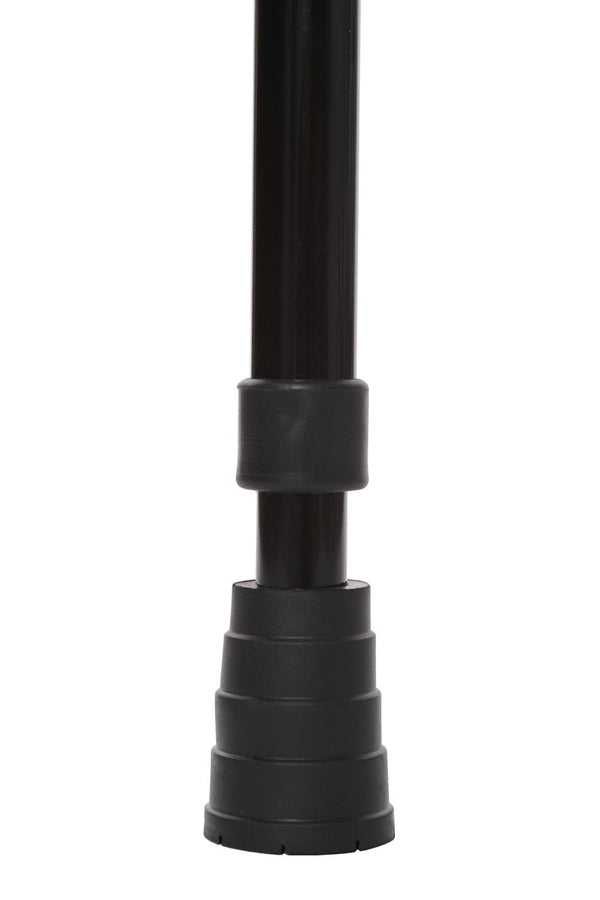
The ferrule is the rubber tip at the bottom of your walking stick, and it's doing more work than you realise. It's the entire contact point between you and the ground, which means a worn, cracked, or poorly fitting ferrule is a genuine safety issue, not just a cosmetic one.
Replace your ferrule before it wears smooth. Once the tread pattern is gone, you've lost most of the grip, particularly on wet or smooth surfaces. As a guide, check it every three months if you use your stick daily.
Different ferrules for different surfaces. Standard rubber ferrules work well on most indoor and outdoor surfaces. If you're walking on wet pavements regularly, a high-performance reinforced ferrule offers significantly better grip. For ice and snow, a ferrule with a metal spike insert is the safest option.
Browse our full ferrule range if yours needs replacing - it's one of the quickest and cheapest ways to make a meaningful difference to your stability.
Does It Matter Which Hand You Hold It In?
Yes, and this trips people up regularly.
The general rule is to hold your walking stick in the opposite hand to your weaker or injured side. So if your left knee is the problem, hold the stick in your right hand.
The reason is biomechanical — when you step forward with your weaker leg, the stick in the opposite hand moves forward at the same time, creating a wider, more stable base and reducing the load on the affected side.
The exception is if you have an injury or condition affecting both sides, or if one hand has significantly weaker grip than the other — in which case comfort and control take priority. Our full guide to which side to use a walking stick on covers the nuances in more detail.

The Part No One Talks About: How It Looks
You're going to use this stick. A lot. Possibly every day, possibly in every social situation you're in for the foreseeable future.
How it looks matters! Not because aesthetics are more important than function, but because you're more likely to use something you actually like, and because you deserve to feel good using it.
A walking stick is not a medical device to be hidden or apologised for. It's a tool that lets you move through the world, and it can reflect your personality just as much as anything else you wear or carry.
Browse our full walking stick collection - from sleek plain styles to bold prints, glitter finishes to bespoke personalised options. There's something for every taste, and every single one is designed to actually work.
If you enjoyed this, you might also like: